Month: July 2026

My Switch from Mac to Linux

I’ve been a Mac user for a long time, and I’m not suddenly an Apple hater. I’m not throwing all my Macs in the trash either. My main desktop is still a Mac Mini M2 Pro hooked up to three monitors, and it’s a great computer. But lately I’ve been spending a whole lot more time with Linux, and somewhere along the way what started out as me screwing around with some old computers turned into something a little more serious.

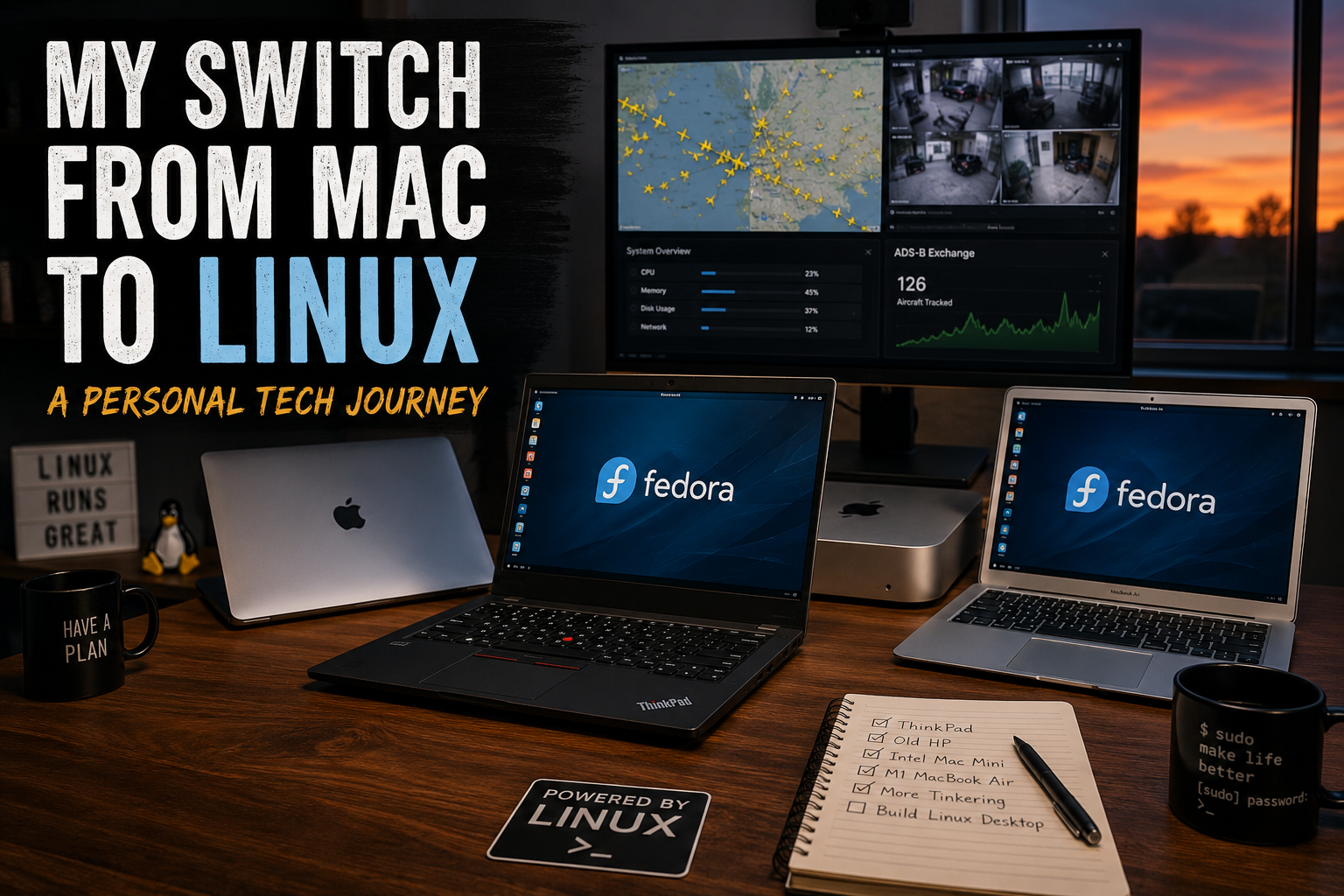
It really started with my ThinkPad. I decided to put Fedora Linux on it, mostly as an experiment to see if I could actually use Linux as a normal everyday computer instead of treating it like some sort of computer science project. Turns out, I can.

I’ve settled on Fedora with GNOME as my favorite setup so far. Once I got GNOME configured the way I like it, especially with Dash to Dock and a few other tweaks, it stopped feeling like somebody else’s idea of how Linux should work and started feeling like my computer. Of course, I couldn’t just leave it alone. I tried switching the ThinkPad over to KDE for a while. That didn’t go particularly well, so eventually I went back to GNOME. I’ve chased down stupid notification dots on the dock, changed keyboard mappings and then forgotten where the hell I changed them, played around with microphones and voice-to-text software, and generally poked at anything that looked like it could be poked at.

And that’s actually part of what I’ve been enjoying about Linux. It lets you screw around with it. You can change things, break things, figure out what you broke, fix them again and learn something along the way. Computers used to be like that.

Once the ThinkPad was working well, things got a little out of hand.

There was an older HP Pavilion laptop sitting around that wasn’t doing much of anything. It’s certainly not a powerhouse. It’s an older AMD machine with 4 GB of RAM and hardware that’s getting close to a decade old. Naturally, I had to find out if it would run Linux.

Fedora went on it first, and that turned into an adventure involving boot problems, black screens, GRUB options, GNOME, GNOME Classic and thoughts about trying XFCE. Eventually I decided to put Zorin OS on it instead, and I’ll be damned if it didn’t work pretty well. It’s never going to be a fast computer, but suddenly this old laptop that wasn’t particularly useful anymore can browse the web, do email and handle normal computer stuff just fine.

That’s one of the things I’m really starting to appreciate about Linux. An old computer doesn’t necessarily have to be an old computer. Sometimes it just needs different software.

Then there was my old Intel Mac Mini. I wasn’t really using it anymore, so of course Linux ended up on that too. Fedora installed on it and runs surprisingly well. That machine now has a specific job. It sits alongside my regular computer and handles things I like having up all day, such as ADS-B Exchange, my security cameras and a few other things. Basically, it has become another screen that doesn’t use any horsepower from my main Mac. It’s an old computer that had pretty much aged out of usefulness for me, and now it has a job again.

Then I decided to see what I could do with my M1 MacBook Air.

This one has probably surprised me the most. Thanks to all the work that’s been done to get Linux running on Apple Silicon, I’ve now got Fedora running on the MacBook Air. That little machine is pretty impressive. It’s barely bigger than an iPad, it’s fast, the Wi-Fi works, the audio works and Fedora runs really well on it.

I’ve tried KDE on that machine too, but once again I ended up back with GNOME. Apparently I’m a GNOME guy now.

One thing I’ve discovered through all of this is that getting the computers set up the same way makes a huge difference. Once I have Dash to Dock configured, my normal applications installed and everything behaving roughly the way I expect, I can move from the ThinkPad to the MacBook Air to the Mac Mini without having to think much about which computer I’m using. The hardware changes, but the basic environment stays the same.

Now, I’m not going to pretend Linux is always easier. It isn’t.

Linux can still send you down some really strange rabbit holes. Something that seems like it should take 30 seconds can turn into an hour of searching the web, typing commands into a terminal and wondering why the hell something isn’t working. I recently spent way too much time trying to get a Chromium web app pinned correctly to the KDE taskbar. I’ve installed things only to discover the command I was trying to use wasn’t there. I’ve hunted through settings trying to find something that I know damn well I changed a few days earlier.

Sometimes Linux makes you work for it.

But here’s the big difference between Linux today and the Linux I remember from years ago. Most of the time, it just works.

Wi-Fi works. Bluetooth works. Audio works. Trackpads work. Web browsers work. Email works. External displays work. Even on some hardware that wasn’t designed with Linux in mind, most of the important stuff works. And when something doesn’t work, there’s usually a way to figure it out.

So why am I doing all this?

I’m not trying to get Apple completely out of my life. My Mac Mini M2 Pro is still an excellent machine, and I’m not going to stop using it just because I’ve discovered Fedora. What I am trying to do is become less dependent on Apple and Microsoft.

I like the idea that my computer isn’t tied quite so tightly to one company. I like being able to decide what desktop I want to use and how I want it to work. I like being able to take a ten-year-old computer, put a different operating system on it and make it useful again.

Mostly, though, I think I’m doing it because it’s fun.

Computers used to be fun to screw around with. You’d upgrade things, change things, install something just to see what happened and occasionally completely screw something up and have to figure out how to fix it. Somewhere along the way, computers became appliances. Macs especially are wonderful appliances. You turn them on, they work and you’re really not supposed to think too much about what’s going on underneath.

Linux feels different. It feels like the computer belongs to me.

At this point, the ThinkPad has become my main Linux laptop and will probably be my travel computer. The little M1 MacBook Air running Fedora is probably going to be the backpack computer. The old Intel Mac Mini has its monitoring duties. Even the ancient HP has found a reason to exist again.

And because apparently I haven’t tinkered enough, I’m already thinking about building a Linux desktop workstation this winter. I’m thinking a couple terabytes of storage, 64 GB of RAM, enough horsepower to play around with running AI models locally, and Fedora as the operating system.

Will it eventually replace my Mac?

Maybe. Maybe not.

That’s really not the point.

This whole thing started because I wanted to see what modern Linux was like. Then I wanted to see if I could actually use it every day. Then I started installing it on damn near every computer I could get my hands on.

Somewhere along the way, I stopped thinking about Linux as an experiment.

Now I’m just using it.

And I’m having a hell of a lot of fun with computers again.
21 Years of Podcasting: The Thing I Don’t Want Us to Lose

I’ve been podcasting for about 21 years now. That’s a strange sentence to write, mostly because when I started, I certainly didn’t imagine I’d still be involved with this stuff more than two decades later.

My first podcast was The Benzoid Report, which I started around 2005.

The setup was about as sophisticated as you’d expect for 2005. I sat on the front porch of my house in Lake Ann, Michigan, with one of those cheap stick microphones that came with a Dell laptop, plugged it in, hit record, and talked.

That was podcasting.

And in a lot of ways, I think it still is.

Somewhere, Episode #1 Might Still Exist

Unfortunately, I’m missing roughly the first 30 episodes of The Benzoid Report.

The original site was BenzoidReport.com, and the show made its way into some of the early podcast directories and services of the time, including Podcast Pickle, Podshow, and GarageBand.com.

I think my naming convention for those early files would have made the first episode something like:

BRP001.mp3

I’ve searched around online and poked through the Internet Archive, but so far I haven’t found it. There is one last place that gives me some hope. I have several old IDE hard drives sitting out in my garage.

One of those drives could very well have those original MP3 files on it. At some point, I’m going to have to get an IDE adapter, hook those things up, image them if they’ll still spin, and go digging. I’d especially like to find episode #1.The funny thing is, I have absolutely no idea what I talked about.

I remember sitting on the porch. I remember the microphone. I remember making the show. But I don’t remember what I actually said in that first episode.Hearing it again would be like opening a little time capsule from 2005.

The Early Podcasting World

Podcasting was a much smaller world then.

I was listed on Podcast Pickle, which was created by Gary Leland, who I came to know personally. There were all sorts of little directories, communities, forums, and services springing up as everybody tried to figure out exactly what this new thing was going to become.

And, of course, there was Todd Cochrane. Founder of Blubrry Podcasting

Todd was my friend and business partner, and our connection went beyond podcasting. We both came from military aviation backgrounds. Todd had worked with Navy aircraft avionics and radar, while I had been in the Air Force working on fighter-type aircraft.

We were both airplane guys. We were both technology guys. And we were both fascinated by podcasting.

Todd unexpectedly passed away in September.

I’m not going to replace Todd. Nobody really could, and trying to duplicate his very visible role in the podcasting industry wouldn’t make much sense anyway.

What I can do is continue advocating for some of the things Todd and I believed were important from the beginning.

One of the biggest is open podcasting.

Podcasting Is Not a Genre

This is something I think gets confused more and more:

Podcasting is a technology and a method of distribution.

You can put almost anything in a podcast.

It can be two people talking. It can be a highly produced documentary. It can be news, comedy, music, education, a business show, somebody rambling from their basement — or somebody sitting on their front porch in Lake Ann with a cheap microphone.

And yes, it can include video.

Audio remains incredibly important to podcasting, but I don’t buy the argument that adding video somehow automatically makes something “not a podcast.”

What matters to me is the open, episodic distribution mechanism behind it.

I think that’s an important distinction because the modern image of “a podcast” can actually discourage people from becoming podcasters.

Look around online and you see studios with four cameras, expensive microphones, lighting rigs, producers, editors, sound treatment, advertising departments and giant audiences.

That’s fine. But none of it is required. You can still turn on a microphone and talk.

Podcasting Was Supposed to Be Free
*Freedom, not free as in free beer*

There was a certain attitude in early podcasting that could probably be summarized as:

“Fuck the FCC”

That wasn’t necessarily about swearing on your podcast. It was about freedom. Traditional radio had licenses, regulations, program directors, station owners and all sorts of gatekeepers deciding what could get on the air. Podcasting didn’t. If you wanted to make a show, you made one. You put an MP3 on a server, added it to an RSS feed and anybody in the world could subscribe to it.

You didn’t have to ask permission. That freedom wasn’t some accidental side effect of podcasting.

It was one of the features.

As podcasting becomes a bigger and increasingly commercial industry, I think we need to be careful that we don’t engineer that freedom out of it.

Advertising Is Part of Podcasting — Not All of It!

I have nothing against companies building large advertising-supported podcast businesses. Advertising companies want better measurement. They want attribution. They want to know whether somebody heard an ad and whether that advertising worked.

That’s understandable.

Blubrry participates in that world too. We support industry measurement standards and are IAB podcast measurement certified. But advertising is only one use case for podcasting.

There are hobby podcasters. There are people building communities. There are experts sharing what they know. There are businesses using podcasts to talk directly to customers. There are independent creators making shows because they simply enjoy doing it.

And there are people like me who sometimes just feel like turning on a microphone and talking about whatever happens to be interesting that day.

Not every podcast needs to maximize impressions, CPMs, attribution or revenue. The podcasting ecosystem needs to work for the giant commercial publisher and the person sitting at home with a microphone.

AMP, Measurement and Privacy

That brings me to the emerging AMP Accords.

There are parts of AMP’s thinking that I find interesting. In particular, I think there’s value in trying to define what actually constitutes a podcast. Some of that definition makes sense to me, including recognizing that podcasting can encompass both audio and video. 

Where I become more cautious is around measurement and client-side listener data. A lot of the organizations involved in these discussions naturally come from advertising, ad technology and other commercial parts of the industry. Their priorities aren’t necessarily wrong. But they’re not necessarily the same priorities as an independent podcaster — or a listener.

One of the things I’ve always appreciated about podcasting as a listener is that it is relatively anonymous. I download an episode and listen to it.

The podcaster doesn’t need to know everything about me. As someone who has spent a good portion of my career working in the podcasting industry, I value that too.

Better analytics can certainly be useful. But requiring podcast applications to provide increasingly detailed client-side listener information changes the relationship between podcasters and their audiences. That’s something we should think very carefully about before deciding it’s automatically “progress.”

Keep Podcasting Permissionless

After 21 years, I keep coming back to one basic principle:

Podcasting should remain open and permissionless.

There should absolutely be room for huge commercial podcast operations.

There should be advertising, analytics, video studios, professional production teams, sophisticated technology and people making very good money doing this. That’s all part of the ecosystem.

But there also needs to be room for somebody who wakes up tomorrow morning with an idea, finds a microphone and decides they have something they want to say. No permission. No gatekeeper. No million-dollar studio. No requirement that it become a business.

Just make a podcast.

Twenty-one years ago, I sat on a porch in Lake Ann, Michigan, plugged a cheap stick microphone into a Dell laptop and recorded The Benzoid Report.

Somewhere in my garage, episode #1 may still be sitting on an old IDE hard drive.

I hope I find it.

But whether I do or not, the thing that allowed me to create it in the first place is still here. And that’s the part of podcasting I want to make sure we don’t lose.