Testing HLS from Blubrry – Take 2

Testing HLS from Blubrry – Take 2

Testing HLS from Blubrry – Take 2

0:03:50

0:00

Thanks for watching and/or listening!

I’m doing a test of some interesting technology that we’re working on here at Blubrry. Recently, we changed our pricing plan to be hours-based versus megabytes-based, so you get X number of hours per month instead of X number of megabytes. This allows you to upload video or audio, and I’m testing the part of the system that encodes the video to what’s called HLS. I uploaded an MP4 for this episode, which is a video file, and our transcoder encoded it in HLS video and also in MP3. Those of you on audio platforms, listen to the MP3. Those of you who are on platforms that will support HLS video will be able to see the video.

Thanks for indulging me on this test, and I will have a regular episode out in the next week or so, I hope. It’ll be the traditional long rambling episodes that I’m well known for.

My Switch from Mac to Linux

I’ve been a Mac user for a long time, and I’m not suddenly an Apple hater. I’m not throwing all my Macs in the trash either. My main desktop is still a Mac Mini M2 Pro hooked up to three monitors, and it’s a great computer. But lately I’ve been spending a whole lot more time with Linux, and somewhere along the way what started out as me screwing around with some old computers turned into something a little more serious.

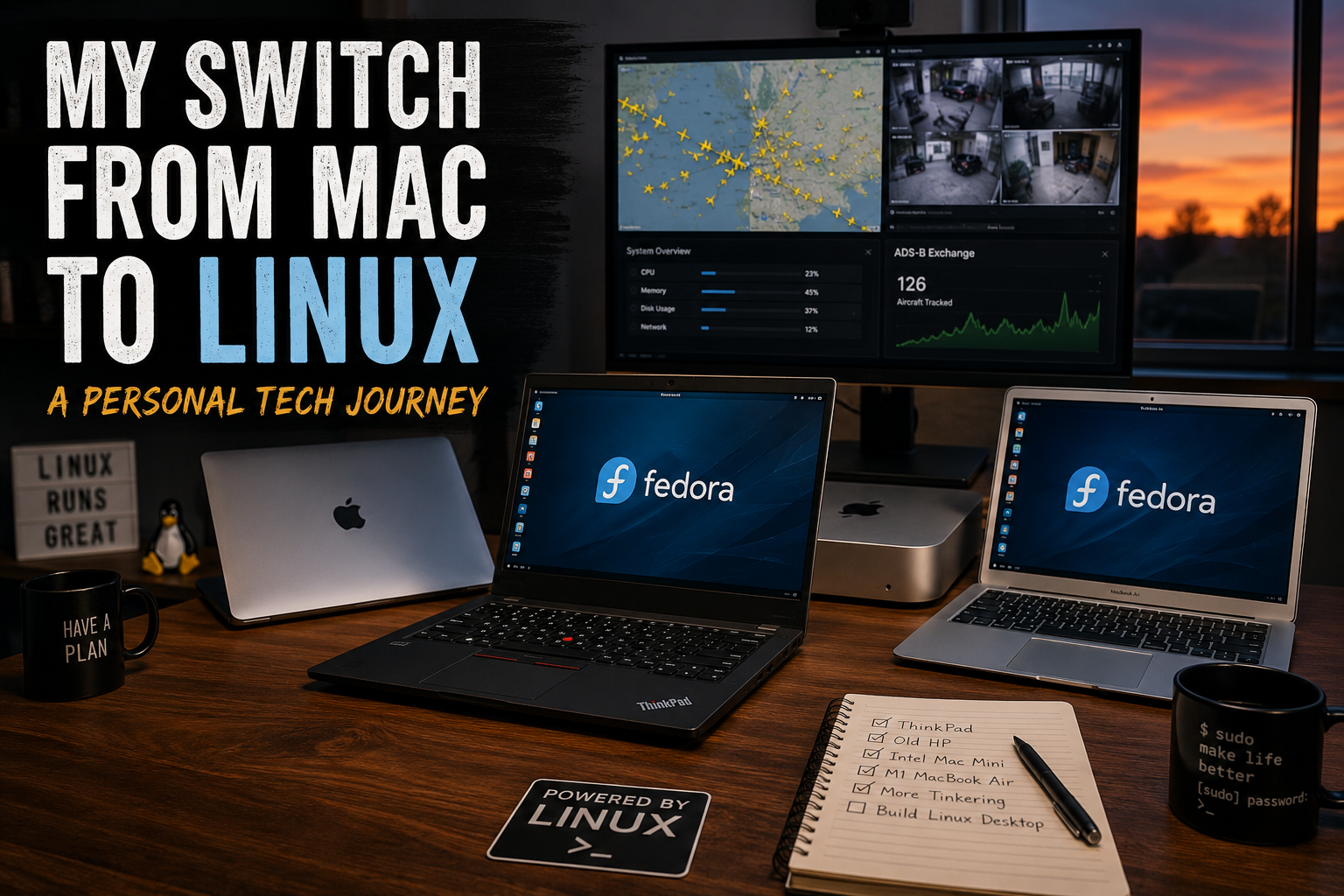
It really started with my ThinkPad. I decided to put Fedora Linux on it, mostly as an experiment to see if I could actually use Linux as a normal everyday computer instead of treating it like some sort of computer science project. Turns out, I can.

I’ve settled on Fedora with GNOME as my favorite setup so far. Once I got GNOME configured the way I like it, especially with Dash to Dock and a few other tweaks, it stopped feeling like somebody else’s idea of how Linux should work and started feeling like my computer. Of course, I couldn’t just leave it alone. I tried switching the ThinkPad over to KDE for a while. That didn’t go particularly well, so eventually I went back to GNOME. I’ve chased down stupid notification dots on the dock, changed keyboard mappings and then forgotten where the hell I changed them, played around with microphones and voice-to-text software, and generally poked at anything that looked like it could be poked at.

And that’s actually part of what I’ve been enjoying about Linux. It lets you screw around with it. You can change things, break things, figure out what you broke, fix them again and learn something along the way. Computers used to be like that.

Once the ThinkPad was working well, things got a little out of hand.

There was an older HP Pavilion laptop sitting around that wasn’t doing much of anything. It’s certainly not a powerhouse. It’s an older AMD machine with 4 GB of RAM and hardware that’s getting close to a decade old. Naturally, I had to find out if it would run Linux.

Fedora went on it first, and that turned into an adventure involving boot problems, black screens, GRUB options, GNOME, GNOME Classic and thoughts about trying XFCE. Eventually I decided to put Zorin OS on it instead, and I’ll be damned if it didn’t work pretty well. It’s never going to be a fast computer, but suddenly this old laptop that wasn’t particularly useful anymore can browse the web, do email and handle normal computer stuff just fine.

That’s one of the things I’m really starting to appreciate about Linux. An old computer doesn’t necessarily have to be an old computer. Sometimes it just needs different software.

Then there was my old Intel Mac Mini. I wasn’t really using it anymore, so of course Linux ended up on that too. Fedora installed on it and runs surprisingly well. That machine now has a specific job. It sits alongside my regular computer and handles things I like having up all day, such as ADS-B Exchange, my security cameras and a few other things. Basically, it has become another screen that doesn’t use any horsepower from my main Mac. It’s an old computer that had pretty much aged out of usefulness for me, and now it has a job again.

Then I decided to see what I could do with my M1 MacBook Air.

This one has probably surprised me the most. Thanks to all the work that’s been done to get Linux running on Apple Silicon, I’ve now got Fedora running on the MacBook Air. That little machine is pretty impressive. It’s barely bigger than an iPad, it’s fast, the Wi-Fi works, the audio works and Fedora runs really well on it.

I’ve tried KDE on that machine too, but once again I ended up back with GNOME. Apparently I’m a GNOME guy now.

One thing I’ve discovered through all of this is that getting the computers set up the same way makes a huge difference. Once I have Dash to Dock configured, my normal applications installed and everything behaving roughly the way I expect, I can move from the ThinkPad to the MacBook Air to the Mac Mini without having to think much about which computer I’m using. The hardware changes, but the basic environment stays the same.

Now, I’m not going to pretend Linux is always easier. It isn’t.

Linux can still send you down some really strange rabbit holes. Something that seems like it should take 30 seconds can turn into an hour of searching the web, typing commands into a terminal and wondering why the hell something isn’t working. I recently spent way too much time trying to get a Chromium web app pinned correctly to the KDE taskbar. I’ve installed things only to discover the command I was trying to use wasn’t there. I’ve hunted through settings trying to find something that I know damn well I changed a few days earlier.

Sometimes Linux makes you work for it.

But here’s the big difference between Linux today and the Linux I remember from years ago. Most of the time, it just works.

Wi-Fi works. Bluetooth works. Audio works. Trackpads work. Web browsers work. Email works. External displays work. Even on some hardware that wasn’t designed with Linux in mind, most of the important stuff works. And when something doesn’t work, there’s usually a way to figure it out.

So why am I doing all this?

I’m not trying to get Apple completely out of my life. My Mac Mini M2 Pro is still an excellent machine, and I’m not going to stop using it just because I’ve discovered Fedora. What I am trying to do is become less dependent on Apple and Microsoft.

I like the idea that my computer isn’t tied quite so tightly to one company. I like being able to decide what desktop I want to use and how I want it to work. I like being able to take a ten-year-old computer, put a different operating system on it and make it useful again.

Mostly, though, I think I’m doing it because it’s fun.

Computers used to be fun to screw around with. You’d upgrade things, change things, install something just to see what happened and occasionally completely screw something up and have to figure out how to fix it. Somewhere along the way, computers became appliances. Macs especially are wonderful appliances. You turn them on, they work and you’re really not supposed to think too much about what’s going on underneath.

Linux feels different. It feels like the computer belongs to me.

At this point, the ThinkPad has become my main Linux laptop and will probably be my travel computer. The little M1 MacBook Air running Fedora is probably going to be the backpack computer. The old Intel Mac Mini has its monitoring duties. Even the ancient HP has found a reason to exist again.

And because apparently I haven’t tinkered enough, I’m already thinking about building a Linux desktop workstation this winter. I’m thinking a couple terabytes of storage, 64 GB of RAM, enough horsepower to play around with running AI models locally, and Fedora as the operating system.

Will it eventually replace my Mac?

Maybe. Maybe not.

That’s really not the point.

This whole thing started because I wanted to see what modern Linux was like. Then I wanted to see if I could actually use it every day. Then I started installing it on damn near every computer I could get my hands on.

Somewhere along the way, I stopped thinking about Linux as an experiment.

Now I’m just using it.

And I’m having a hell of a lot of fun with computers again.

21 Years of Podcasting: The Thing I Don’t Want Us to Lose

I’ve been podcasting for about 21 years now. That’s a strange sentence to write, mostly because when I started, I certainly didn’t imagine I’d still be involved with this stuff more than two decades later.

My first podcast was The Benzoid Report, which I started around 2005.

The setup was about as sophisticated as you’d expect for 2005. I sat on the front porch of my house in Lake Ann, Michigan, with one of those cheap stick microphones that came with a Dell laptop, plugged it in, hit record, and talked.

That was podcasting.

And in a lot of ways, I think it still is.

Somewhere, Episode #1 Might Still Exist

Unfortunately, I’m missing roughly the first 30 episodes of The Benzoid Report.

The original site was BenzoidReport.com, and the show made its way into some of the early podcast directories and services of the time, including Podcast Pickle, Podshow, and GarageBand.com.

I think my naming convention for those early files would have made the first episode something like:

BRP001.mp3

I’ve searched around online and poked through the Internet Archive, but so far I haven’t found it. There is one last place that gives me some hope. I have several old IDE hard drives sitting out in my garage.

One of those drives could very well have those original MP3 files on it. At some point, I’m going to have to get an IDE adapter, hook those things up, image them if they’ll still spin, and go digging. I’d especially like to find episode #1.The funny thing is, I have absolutely no idea what I talked about.

I remember sitting on the porch. I remember the microphone. I remember making the show. But I don’t remember what I actually said in that first episode.Hearing it again would be like opening a little time capsule from 2005.

The Early Podcasting World

Podcasting was a much smaller world then.

I was listed on Podcast Pickle, which was created by Gary Leland, who I came to know personally. There were all sorts of little directories, communities, forums, and services springing up as everybody tried to figure out exactly what this new thing was going to become.

And, of course, there was Todd Cochrane. Founder of Blubrry Podcasting

Todd was my friend and business partner, and our connection went beyond podcasting. We both came from military aviation backgrounds. Todd had worked with Navy aircraft avionics and radar, while I had been in the Air Force working on fighter-type aircraft.

We were both airplane guys. We were both technology guys. And we were both fascinated by podcasting.

Todd unexpectedly passed away in September.

I’m not going to replace Todd. Nobody really could, and trying to duplicate his very visible role in the podcasting industry wouldn’t make much sense anyway.

What I can do is continue advocating for some of the things Todd and I believed were important from the beginning.

One of the biggest is open podcasting.

Podcasting Is Not a Genre

This is something I think gets confused more and more:

Podcasting is a technology and a method of distribution.

You can put almost anything in a podcast.

It can be two people talking. It can be a highly produced documentary. It can be news, comedy, music, education, a business show, somebody rambling from their basement — or somebody sitting on their front porch in Lake Ann with a cheap microphone.

And yes, it can include video.

Audio remains incredibly important to podcasting, but I don’t buy the argument that adding video somehow automatically makes something “not a podcast.”

What matters to me is the open, episodic distribution mechanism behind it.

I think that’s an important distinction because the modern image of “a podcast” can actually discourage people from becoming podcasters.

Look around online and you see studios with four cameras, expensive microphones, lighting rigs, producers, editors, sound treatment, advertising departments and giant audiences.

That’s fine. But none of it is required. You can still turn on a microphone and talk.

Podcasting Was Supposed to Be Free
*Freedom, not free as in free beer*

There was a certain attitude in early podcasting that could probably be summarized as:

“Fuck the FCC”

That wasn’t necessarily about swearing on your podcast. It was about freedom. Traditional radio had licenses, regulations, program directors, station owners and all sorts of gatekeepers deciding what could get on the air. Podcasting didn’t. If you wanted to make a show, you made one. You put an MP3 on a server, added it to an RSS feed and anybody in the world could subscribe to it.

You didn’t have to ask permission. That freedom wasn’t some accidental side effect of podcasting.

It was one of the features.

As podcasting becomes a bigger and increasingly commercial industry, I think we need to be careful that we don’t engineer that freedom out of it.

Advertising Is Part of Podcasting — Not All of It!

I have nothing against companies building large advertising-supported podcast businesses. Advertising companies want better measurement. They want attribution. They want to know whether somebody heard an ad and whether that advertising worked.

That’s understandable.

Blubrry participates in that world too. We support industry measurement standards and are IAB podcast measurement certified. But advertising is only one use case for podcasting.

There are hobby podcasters. There are people building communities. There are experts sharing what they know. There are businesses using podcasts to talk directly to customers. There are independent creators making shows because they simply enjoy doing it.

And there are people like me who sometimes just feel like turning on a microphone and talking about whatever happens to be interesting that day.

Not every podcast needs to maximize impressions, CPMs, attribution or revenue. The podcasting ecosystem needs to work for the giant commercial publisher and the person sitting at home with a microphone.

AMP, Measurement and Privacy

That brings me to the emerging AMP Accords.

There are parts of AMP’s thinking that I find interesting. In particular, I think there’s value in trying to define what actually constitutes a podcast. Some of that definition makes sense to me, including recognizing that podcasting can encompass both audio and video. 

Where I become more cautious is around measurement and client-side listener data. A lot of the organizations involved in these discussions naturally come from advertising, ad technology and other commercial parts of the industry. Their priorities aren’t necessarily wrong. But they’re not necessarily the same priorities as an independent podcaster — or a listener.

One of the things I’ve always appreciated about podcasting as a listener is that it is relatively anonymous. I download an episode and listen to it.

The podcaster doesn’t need to know everything about me. As someone who has spent a good portion of my career working in the podcasting industry, I value that too.

Better analytics can certainly be useful. But requiring podcast applications to provide increasingly detailed client-side listener information changes the relationship between podcasters and their audiences. That’s something we should think very carefully about before deciding it’s automatically “progress.”

Keep Podcasting Permissionless

After 21 years, I keep coming back to one basic principle:

Podcasting should remain open and permissionless.

There should absolutely be room for huge commercial podcast operations.

There should be advertising, analytics, video studios, professional production teams, sophisticated technology and people making very good money doing this. That’s all part of the ecosystem.

But there also needs to be room for somebody who wakes up tomorrow morning with an idea, finds a microphone and decides they have something they want to say. No permission. No gatekeeper. No million-dollar studio. No requirement that it become a business.

Just make a podcast.

Twenty-one years ago, I sat on a porch in Lake Ann, Michigan, plugged a cheap stick microphone into a Dell laptop and recorded The Benzoid Report.

Somewhere in my garage, episode #1 may still be sitting on an old IDE hard drive.

I hope I find it.

But whether I do or not, the thing that allowed me to create it in the first place is still here. And that’s the part of podcasting I want to make sure we don’t lose.

Life, Health, Death and Tech

– The episode opens with a short introduction from Donald Trump praising “one of the most successful business leaders… Michael Dell” and his “really exciting announcement.”

– Brett Butt follows with a nostalgic anecdote about growing up before the Internet and World Wide Web, and remembering early video games like Pac-Man, Asteroids, Wizard of War, Scrambled, and Defender. He jokes about wishing for something people now have.

– Mike Dell then introduces himself (“Like Dell’s World… That’s me”) and frames the episode as covering two major topics: technology (how tech works and is used) and personal updates. He notes customer service issues he’d complained about previously have not improved.

– Personal updates:
– He reports attending multiple recent funerals: mentions having been to “three funerals in the last six months, or two,” and that he’s about to go to another in Detroit that weekend.
– He names specific losses: Todd Cochran, founder of Blubrry, who passed “late summer, early fall”; his wife’s best friend Mary in Grand Haven, who died of lung problems and was younger than them; and his uncle Bill Busby, who turned eighty-eight at a recent party, helped start Motorola Semiconductors, was a US Air Force veteran (crew chief on a B-57 or B-58), and then passed away Monday morning. He says he and his nearly 98–99-year-old grandmother will be traveling to Detroit for that funeral.
– Health update: Mike had a torn retina in his right eye, underwent emergency surgery, had to be face-down post-op while a bubble/oil was placed in the eye. At his second post-op checkup the doctor said things are looking good; vision in that eye is blurred by the oil bubble while the other eye is 20/20. He expects the oil to be removed and vision to clear later. He says this grounds him for about six weeks.
– He mentions a lingering low-level cold over the past month.

– Recent events and work:
– He attended Military Creator Con in Arlington, Texas (several hundred participants, veterans/active military/spouses), where he saw Jamie Jay, Christopher Lochhead, Gordon Firemark (podcast lawyer), and others. The event ran long days and was busy but enjoyable.
– At Blubrry he’s been promoted to VP of Operations, overseeing teams and day-to-day work; Barry (another cofounder) is now CEO. He encourages podcasters to contact him for help, states he uses Blubrry hosting and the PowerPress plugin, and plugs Blubrry’s services.

– Technology and AI:
– He discusses AI-generated content broadly: YouTube’s proliferation of AI-narrated slideshow-style or AI-generated videos; his guilty pleasure of “AI Karen stories” on YouTube (which he knows are AI and mostly fiction).
– He references a MacRumors article reporting YouTube will automatically label AI videos even if creators don’t, and applauds the move, predicting many viewers will prefer non-AI content when labeled.
– He raises concerns about AI in podcasting: AI-voiced podcasts and companies generating massive amounts of AI podcast content. He names a company, Inception PointAI, that reportedly generated a lot of AI podcast content and moved from Spreaker to Megaphone/Spotify; he says such AI content can hallucinate and produce factually untrue information, and that some AI podcasts present content as true.
– He describes his own measured use of AI: he uses AI for transcripts and some artwork that he then tweaks, and he tried a cloned AI voice for one episode a few years ago but it didn’t sound right. He notes telltale patterns of AI-written scripts and advises never to ask AI for its opinion.
– He touches on scams: modern scam emails are harder to spot because language models clean up grammar; he warns about requests for immediate payment, iTunes/gift cards, or crypto as signs of scams.

– Advertising and social media observations:
– Criticizes YouTube mid-roll ads that interrupt videos, and the perceived decline in value of TV ads—locally seeing many online gambling ads in Michigan.
– Observes AI activity on Facebook: AI agents entering groups to start conversations (sometimes inane or provocative) and AI-generated video shorts (e.g., airplanes doing impossible things). He dislikes Facebook’s prompts to read more on Threads and says he doesn’t want more social media accounts. He mentions being on LinkedIn, using X a little, and participating on Reddit, and says he plans to use a flip phone when he retires.

YouTube Will Now Automatically Label AI Videos Even When Creators Don’t

– Podcasting industry and advice:
– Clarifies his use of “podcast” to mean generally audio (though he acknowledges podcasts can be video) and emphasizes that podcasting is a distribution method open to anyone.
– Contrasts highly produced, broadcast-style podcasts (teams of producers and sound designers) with indie, authentic podcasts (one person talking into a microphone from a shed). He values indie authenticity and accessibility.
– References a report by Tom Webster of Sounds Profitable noting people seek authentic-sounding podcast audio. He warns the industry is bifurcating between highly produced shows and indie creators.
– Gives practical advice: podcasting is inexpensive and accessible (buy a microphone, record, compress to MP3, upload to hosting or WordPress to create an RSS feed). Suggests inexpensive cover art via Fiverr and mentions Blubrry hosting around fifteen dollars. Warns that podcasting generally won’t replace a day job quickly—monetization takes time and consistency.
– Lists three elements for podcast success: consistency, authenticity, and having content that is interesting/informative/compelling (he stumbles on phrasing but leaves the point authentic). He notes technology barriers are lower now; you don’t have to be a geek.
– Explains distribution parity: small indie shows can sit beside big shows like Joe Rogan in directories; one can succeed without becoming huge. His personal goal is to have a place to speak freely rather than chase large monetization.

– Plans and format changes:
– He says they will restart the Podcast Insider show with a revamped, more conversational format with two or three hosts discussing industry trends (e.g., trend toward video).
– Discusses video: video has always been part of podcasting but is getting more prominent; video production is harder (lighting, appearance, editing). Blubrry is working on a video product to better support creators.
– Mentions his short-form series “Cup of Traverse City” (daily, five minutes) which he took a month off from and tried to restart; he intends for it to be five days a week, five minutes, when resumed.
– Reiterates he podcasts when it’s fun and will take breaks when needed.

– Closing:
– He notes he has been talking for forty-five minutes, asks listeners if they’re still subscribed and what they think about technology trends (is tech “going off the deep end” or is he being a curmudgeon?), invites feedback via email (mike at mike dell dot com), and signs off saying “Catch me later.”

What happened to customer service?

I stopped into a Shell station tonight to grab a couple things. Quick in and out. That was the plan.

Instead I walked into one of those forced self checkout setups. No regular checkout. No cashier. Just this open area with cameras hanging over it where you’re supposed to set your stuff down and trust that some mystery system scans every barcode at once. It is not a normal self checkout with a screen and a scanner you control. It’s just awkward. Confusing. And honestly a little uncomfortable.

I asked the person behind the counter if I had to use it. She said no, she could check me out “over there,” pointing at the regular register. The same register that was blocked off and covered in signs telling everyone to use the self checkout. So clearly that was not the plan.

She was visibly irritated that I even asked.

She rang me up manually. Didn’t ask if I needed a bag. I had four items that were not exactly pocket sized. Didn’t offer a receipt. The whole interaction felt like I was a problem for simply wanting to pay for what I was buying.

What happened to basic customer service?

Nobody asks if you need a bag anymore. They just assume you don’t. You get side eyed if you want to use cash. And more and more, it feels like asking someone to do the core function of their job is some massive inconvenience.

I work in customer service every day. Different space. Software, podcast hosting, support tickets, real technical problems. But the principle is the same. When someone asks for help, especially something completely reasonable and within scope, you help them. You do not act annoyed. You do not make them feel like they are in the way.

And you definitely do not expect applause (A Tip) for doing the bare minimum.

Legacy Aviation Learning Center in Traverse City – Interview with the founder, Dan Jonkhoff

In this episode of “Mike Dell’s World,” host Mike Dell interviews Dan Jonkhoff, the founder and chairman of Legacy Aviation Learning Center in Traverse City. The episode discusses the unique opportunity to earn an Airframe and Powerplant (A&P) license in just one year, as opposed to the typical two or more years required by other programs.
He begins the interview with Dan, who shares his background as a former funeral director and his journey into aviation. Dan discusses how his retirement was dull, prompting him to seek involvement in the airport authority, leading to the creation of Legacy Aviation.

The conversation covers the school’s unique one-year program, facilitated by new FAA regulations aimed at addressing a significant shortage of A&P mechanics projected in the coming years. Dan explains how they turned the idea of creating a mechanic school into reality, assisted by Dr. Sean Galligan, who helped them develop the program within a year. The school allows students to learn in a hands-on environment, focusing on practical experience with various projects like safety wiring and riveting.

Dan highlights that students can expect a tight-knit learning environment, with a favorable instructor-to-student ratio, and discusses the school’s job placement success rate, boasting that all graduates find jobs shortly after completing their training. He outlines how the school has gradually increased its student enrollment and plans to accept even more in the future.

Throughout the interview, they touch on the various learning facilities, the support for veterans, and the exciting community atmosphere that has emerged around the school. The program includes additional support to ensure all students can take their FAA licensing exams without the financial burden typically associated with such tests.

We did it! (Ok, I did it!) – Introducing Cup Of Traverse City

Episode 30 of NaPodPoMo2025 is in the books, and it’s got me thinking — I’m not quite ready to stop doing daily episodes. But instead of continuing that here on Mike Dell’s World, I’m spinning up something new.

Starting December 1st, 2025, I’m launching a brand-new weekday morning show called “Cup of Traverse City.” You’ll find it on its own feed at:

The plan is simple: a 5-minute (or so) episode every weekday around 8 a.m. Traverse City time. I’ll be recording while I’m having my morning coffee, chatting about whatever’s going on — interesting weather, life stuff, and what’s happening in and around Northern Michigan.

The format will be a bit of a work in progress at first. I’m sure I’ll settle into a groove over time, and my hope is that it becomes a nice little part of your morning routine.

I’d really love your feedback as this gets rolling.

You can reach me:

  • By email: mike@mikedell.com

  • On social media: mostly Facebook or X

Let me know what you think, and what you’d like me to talk about on Cup of Traverse City.


Why Podcasting is Special

In this episode, I spend some time reflecting on what makes podcasting such a unique and enduring medium. After more than twenty years behind the microphone, I’m still struck by how something so simple — an audio file delivered through a humble RSS feed — continues to connect people in a way no other medium really does.

I talk about how podcasting grew up as an open technology, free from the control of big platforms or gatekeepers. That openness is part of its magic. Anyone can start a show, anyone can subscribe, and no single company controls whether a podcast lives or dies. It’s the last truly open publishing system on the internet, and that freedom is worth celebrating.

But podcasting is special for more than just the technology. There’s a kind of intimacy in audio that you don’t get with video or with text on a screen. When someone listens to a podcast, the host is right there with them — in their car, on a walk, working in the garage, or flying along on a cross-country in the RV-12. It’s a personal connection, one voice to one listener, in a way that feels almost old-fashioned, yet perfectly modern.

I also talk about how easy podcasting is to get started with and how accessible it still is for anyone who wants to share a story. You don’t need fancy cameras or editing suites. You just need a microphone, a place to publish, and something to say. That simplicity has helped the medium grow without losing its soul.

Toward the end, I share a bit of personal appreciation — how even after all these years, podcasting still feels fun, creative, and liberating. It’s a place where I can talk about anything from Northern Michigan history to flying to everyday life, and people choose to come along for the ride.

If you’ve ever wondered why podcasting still matters, or if you’ve been thinking about starting your own show, this episode is my way of reminding you what makes this medium so special.

Traverse City State Hospital

In this episode, Mike dives into the deep and fascinating history of one of Traverse City’s most iconic landmarks: the Traverse City State Hospital, also known historically as the Northern Michigan Asylum and the Traverse City Regional Psychiatric Hospital.

Recorded on November 28, 2025 (yes, Black Friday—no, he’s not out shopping), Mike shares personal stories, local history, and some memories connected to the vast and beautiful grounds of what is now called the Village at Grand Traverse Commons.

What Mike Covers in This Episode

🏥 A Brief History of the State Hospital

  • Established in 1881 and opened in 1885.

  • Founded by Dr. James Decker Munson, namesake of Munson Healthcare, alongside Traverse City’s “father,” Perry Hanna.

  • Built as a Kirkbride Plan psychiatric hospital—one of four in Michigan and the only one still standing and in active use today (though no longer as a hospital).

🏛️ Architecture & Design

  • Beautiful Victorian-style buildings with spires, long wings, wide porches, and landscaped grounds.

  • Built on the idea of beauty, light, and nature aiding psychiatric healing.

  • Gorgeous gardens supported by on-site greenhouses that provided year-round flowers.

🌳 A Self-Sustaining Community

  • The hospital operated as its own little world:

    • Farms with cattle, pigs, chickens, crops, and orchards

    • Their own power plant

    • Workshops and barns (now part of Historic Barns Park)

  • Many patients (or “clients,” as some staff called them) worked on the grounds as part of daily life.

👨‍⚕️ Mike’s Personal Connections

  • Both of Mike’s paternal grandparents worked there—his grandmother as an RN and his grandfather as an orderly.

  • He shares memories of neighbors and relatives who worked on the hospital farm and grounds.

  • He also reminisces about staying as a kid in the Perry Hanna House (now a funeral home)—a mansion connected to the founders of the hospital.

🏚️ Abandonment and Renewal

  • After closing in the late 20th century, some buildings fell into disrepair.

  • Today, Building 50 has been reborn with:

    • Condos and apartments

    • Offices

    • Shops, galleries, and restaurants in the lower level, known as The Grotto

  • Other “cottages” are slowly being restored, while tours still visit the untouched and eerie sections.

🚶 Ghost Stories, Tunnels & Tours

  • The site is rich with lore—including tunnels connecting buildings.

  • Mike mentions wanting to have his friend Chris (a local historian and photographer) on the podcast to go deeper into the legends, stories, and details.

☕ Coffee Deliveries at Sunrise

Mike also shares a personal memory of delivering bagels to Cup of Joe in Building 50’s grotto back when his wife ran a bagel shop—always grabbing a cup of coffee around 5:30 a.m.

🌄 A Landmark on the Hill

  • As you drive into Traverse City from the south (US-31 / M-37), the spires of Building 50 rise out of the trees—a recognizable introduction to town.

🎙️ Coming Up

  • November 29: “Why Podcasting Is So Special”

  • November 30: A special final NaPodPoMo episode to close out the month

Thanks for listening, and catch Mike tomorrow for more!


Traverse City is still a small town, or is it?

In this Thanksgiving Day episode, Mike reflects on the holiday, family, and the evolving character of Traverse City. It’s a bittersweet year—his family’s first Thanksgiving without his dad—but also a moment to appreciate traditions, good food, and time spent together.

From recent crime stories to long-standing local quirks, Mike explores whether Traverse City still feels like the small town he grew up in. He shares personal stories, local history, neighborhood breakdowns, and observations about everything from fast food failures to the layout of the airport and high schools.

Topics Covered

Thanksgiving Reflections

  • Sending well-wishes to listeners celebrating the holiday.

  • The first Thanksgiving without Mike’s dad and the tradition of leaving an empty chair at the table.

Is Traverse City Still a Small Town?

  • Recent unusual crime events:

    • The Walmart stabbing last summer.

    • A fatal parking-deck shooting involving car break-ins.

    • An attempted abduction at the Meijer gas station.

  • Why these big incidents still feel like “small-town news.”

Population & Geography

  • 2020 Census: About 16,000 people inside Traverse City limits.

  • Metro area: ~153,000 across four counties (Grand Traverse, Leelanau, Benzie, Kalkaska).

  • Mike’s spot just outside the city—technically East Bay Township, but “still Traverse City” in daily life.

Neighborhoods & Areas Mentioned

  • Downtown District

  • Traverse Heights

  • Old Town

  • Central Neighborhoods

  • Greilickville

  • Acme / Williamsburg

  • “Miracle Mile” – hotels and tourist strip on the bay

Tourism & Seasons

  • Summer vs. winter crowds

  • Winter visitors: snowmobilers, skiers, ice fishermen

  • Bars downtown still feel local and familiar in the off-season

Traverse City Schools

  • Current schools: Central, West, Traverse City High School (Mavericks), plus Catholic Central.

  • Stories about the old buildings, snow-exposed walkways, and campus redesigns.

  • The near-identical design of TC West and the Columbine High School campus.

Airports & Travel

  • Cherry Capital Airport still feels small—Mike knows most of the airline and TSA staff.

  • No Amtrak service in Traverse City yet; nearest connections are Grand Rapids or Holland.

  • Mike’s go-to workaround: driving to New Buffalo to catch the train to Chicago.

Parking & Downtown Life

  • Legacy of parking meters (now digital), plus multiple parking decks.

  • Cherry Festival setup: rides, games, food stands—including local favorite Gibby Fries.

  • Arnold Amusements (based in Acme) runs many Michigan carnivals.

Roundabouts, Traffic, and Small-Town Quirks

  • Late-night flashing signals

  • The ongoing roundabout debate

  • Getting across town in only ~15 minutes even on a busy day

Fast Food in Traverse City – A Unique Landscape

  • Chains that didn’t survive: several McDonald’s, Burger Kings, Arby’s, Ruby Tuesday, Hooters

  • Three Meijer stores serving the area (original, Acme/Williamsburg, and soon Chum’s Corners)

  • Local burger highlights: Slabtown Burgers, Bubba’s, Eastfield’s Proper Burger (with commentary)

Local Dining Identity

  • Traverse City tends to favor local restaurants over big chains

  • Well-loved local Mexican places like La Señorita

Closing Thoughts

Mike wraps up with a warm Thanksgiving message—hoping listeners enjoy good food, family, and gratitude—and shares appreciation for being able to create a daily episode for NaPodPoMo.