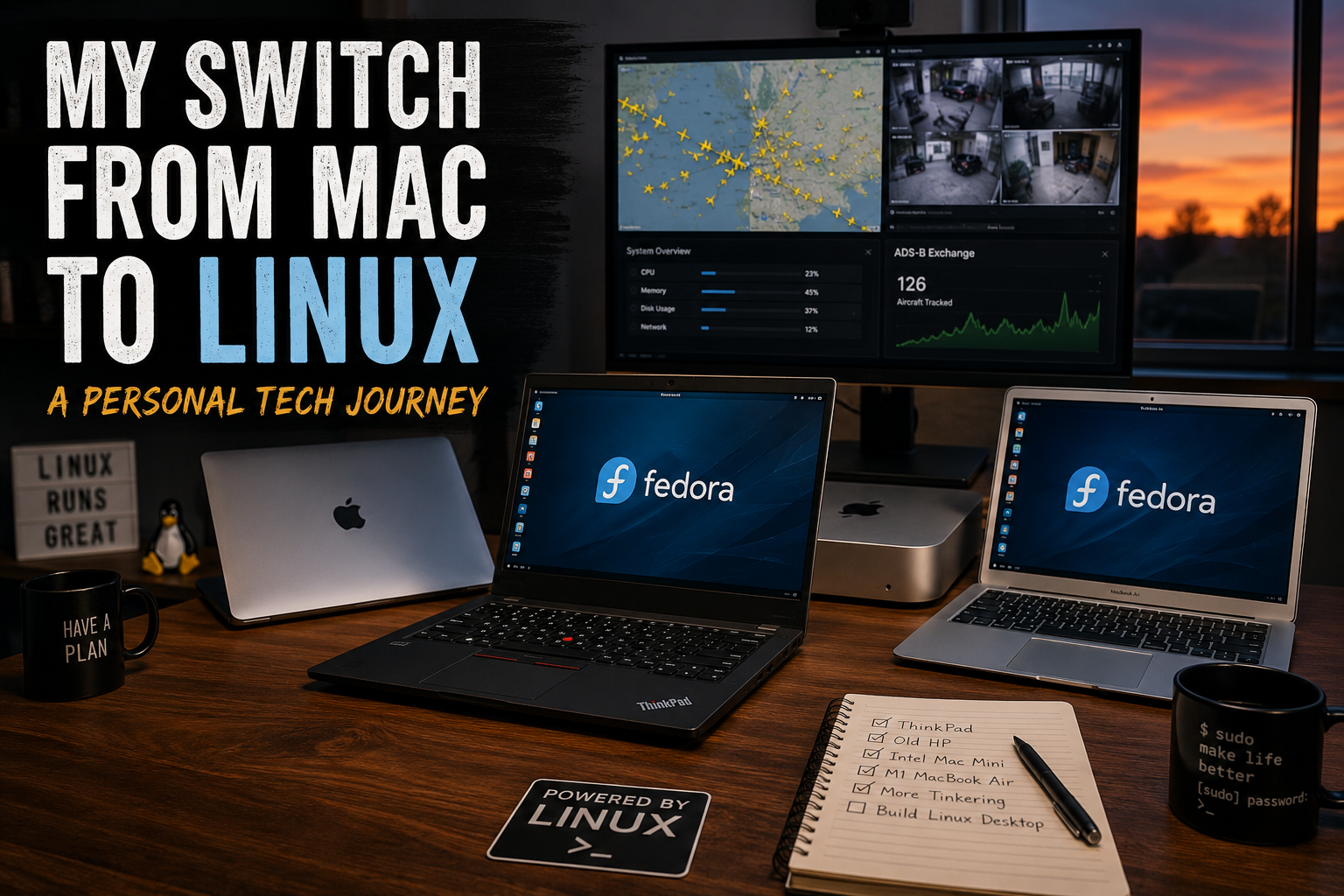
I’ve been a Mac user for a long time, and I’m not suddenly an Apple hater. I’m not throwing all my Macs in the trash either. My main desktop is still a Mac Mini M2 Pro hooked up to three monitors, and it’s a great computer. But lately I’ve been spending a whole lot more time with Linux, and somewhere along the way what started out as me screwing around with some old computers turned into something a little more serious.
It really started with my ThinkPad. I decided to put Fedora Linux on it, mostly as an experiment to see if I could actually use Linux as a normal everyday computer instead of treating it like some sort of computer science project. Turns out, I can.
I’ve settled on Fedora with GNOME as my favorite setup so far. Once I got GNOME configured the way I like it, especially with Dash to Dock and a few other tweaks, it stopped feeling like somebody else’s idea of how Linux should work and started feeling like my computer. Of course, I couldn’t just leave it alone. I tried switching the ThinkPad over to KDE for a while. That didn’t go particularly well, so eventually I went back to GNOME. I’ve chased down stupid notification dots on the dock, changed keyboard mappings and then forgotten where the hell I changed them, played around with microphones and voice-to-text software, and generally poked at anything that looked like it could be poked at.
And that’s actually part of what I’ve been enjoying about Linux. It lets you screw around with it. You can change things, break things, figure out what you broke, fix them again and learn something along the way. Computers used to be like that.
Once the ThinkPad was working well, things got a little out of hand.
There was an older HP Pavilion laptop sitting around that wasn’t doing much of anything. It’s certainly not a powerhouse. It’s an older AMD machine with 4 GB of RAM and hardware that’s getting close to a decade old. Naturally, I had to find out if it would run Linux.
Fedora went on it first, and that turned into an adventure involving boot problems, black screens, GRUB options, GNOME, GNOME Classic and thoughts about trying XFCE. Eventually I decided to put Zorin OS on it instead, and I’ll be damned if it didn’t work pretty well. It’s never going to be a fast computer, but suddenly this old laptop that wasn’t particularly useful anymore can browse the web, do email and handle normal computer stuff just fine.
That’s one of the things I’m really starting to appreciate about Linux. An old computer doesn’t necessarily have to be an old computer. Sometimes it just needs different software.
Then there was my old Intel Mac Mini. I wasn’t really using it anymore, so of course Linux ended up on that too. Fedora installed on it and runs surprisingly well. That machine now has a specific job. It sits alongside my regular computer and handles things I like having up all day, such as ADS-B Exchange, my security cameras and a few other things. Basically, it has become another screen that doesn’t use any horsepower from my main Mac. It’s an old computer that had pretty much aged out of usefulness for me, and now it has a job again.
Then I decided to see what I could do with my M1 MacBook Air.
This one has probably surprised me the most. Thanks to all the work that’s been done to get Linux running on Apple Silicon, I’ve now got Fedora running on the MacBook Air. That little machine is pretty impressive. It’s barely bigger than an iPad, it’s fast, the Wi-Fi works, the audio works and Fedora runs really well on it.
I’ve tried KDE on that machine too, but once again I ended up back with GNOME. Apparently I’m a GNOME guy now.
One thing I’ve discovered through all of this is that getting the computers set up the same way makes a huge difference. Once I have Dash to Dock configured, my normal applications installed and everything behaving roughly the way I expect, I can move from the ThinkPad to the MacBook Air to the Mac Mini without having to think much about which computer I’m using. The hardware changes, but the basic environment stays the same.
Now, I’m not going to pretend Linux is always easier. It isn’t.
Linux can still send you down some really strange rabbit holes. Something that seems like it should take 30 seconds can turn into an hour of searching the web, typing commands into a terminal and wondering why the hell something isn’t working. I recently spent way too much time trying to get a Chromium web app pinned correctly to the KDE taskbar. I’ve installed things only to discover the command I was trying to use wasn’t there. I’ve hunted through settings trying to find something that I know damn well I changed a few days earlier.
Sometimes Linux makes you work for it.
But here’s the big difference between Linux today and the Linux I remember from years ago. Most of the time, it just works.
Wi-Fi works. Bluetooth works. Audio works. Trackpads work. Web browsers work. Email works. External displays work. Even on some hardware that wasn’t designed with Linux in mind, most of the important stuff works. And when something doesn’t work, there’s usually a way to figure it out.
So why am I doing all this?
I’m not trying to get Apple completely out of my life. My Mac Mini M2 Pro is still an excellent machine, and I’m not going to stop using it just because I’ve discovered Fedora. What I am trying to do is become less dependent on Apple and Microsoft.
I like the idea that my computer isn’t tied quite so tightly to one company. I like being able to decide what desktop I want to use and how I want it to work. I like being able to take a ten-year-old computer, put a different operating system on it and make it useful again.
Mostly, though, I think I’m doing it because it’s fun.
Computers used to be fun to screw around with. You’d upgrade things, change things, install something just to see what happened and occasionally completely screw something up and have to figure out how to fix it. Somewhere along the way, computers became appliances. Macs especially are wonderful appliances. You turn them on, they work and you’re really not supposed to think too much about what’s going on underneath.
Linux feels different. It feels like the computer belongs to me.
At this point, the ThinkPad has become my main Linux laptop and will probably be my travel computer. The little M1 MacBook Air running Fedora is probably going to be the backpack computer. The old Intel Mac Mini has its monitoring duties. Even the ancient HP has found a reason to exist again.
And because apparently I haven’t tinkered enough, I’m already thinking about building a Linux desktop workstation this winter. I’m thinking a couple terabytes of storage, 64 GB of RAM, enough horsepower to play around with running AI models locally, and Fedora as the operating system.
Will it eventually replace my Mac?
Maybe. Maybe not.
That’s really not the point.
This whole thing started because I wanted to see what modern Linux was like. Then I wanted to see if I could actually use it every day. Then I started installing it on damn near every computer I could get my hands on.
Somewhere along the way, I stopped thinking about Linux as an experiment.
Now I’m just using it.
And I’m having a hell of a lot of fun with computers again.