Category: Blog Post

21 Years of Podcasting: The Thing I Don’t Want Us to Lose

I’ve been podcasting for about 21 years now. That’s a strange sentence to write, mostly because when I started, I certainly didn’t imagine I’d still be involved with this stuff more than two decades later.

My first podcast was The Benzoid Report, which I started around 2005.
The setup was about as sophisticated as you’d expect for 2005. I sat on the front porch of my house in Lake Ann, Michigan, with one of those cheap stick microphones that came with a Dell laptop, plugged it in, hit record, and talked.

That was podcasting.

And in a lot of ways, I think it still is.

Somewhere, Episode #1 Might Still Exist

Unfortunately, I’m missing roughly the first 30 episodes of The Benzoid Report.

The original site was BenzoidReport.com, and the show made its way into some of the early podcast directories and services of the time, including Podcast Pickle, Podshow, and GarageBand.com.

I think my naming convention for those early files would have made the first episode something like:

BRP001.mp3

I’ve searched around online and poked through the Internet Archive, but so far I haven’t found it. There is one last place that gives me some hope. I have several old IDE hard drives sitting out in my garage.

One of those drives could very well have those original MP3 files on it. At some point, I’m going to have to get an IDE adapter, hook those things up, image them if they’ll still spin, and go digging. I’d especially like to find episode #1.The funny thing is, I have absolutely no idea what I talked about.

I remember sitting on the porch. I remember the microphone. I remember making the show. But I don’t remember what I actually said in that first episode.Hearing it again would be like opening a little time capsule from 2005.

The Early Podcasting World

Podcasting was a much smaller world then.

I was listed on Podcast Pickle, which was created by Gary Leland, who I came to know personally. There were all sorts of little directories, communities, forums, and services springing up as everybody tried to figure out exactly what this new thing was going to become.

And, of course, there was Todd Cochrane. Founder of Blubrry Podcasting

Todd was my friend and business partner, and our connection went beyond podcasting. We both came from military aviation backgrounds. Todd had worked with Navy aircraft avionics and radar, while I had been in the Air Force working on fighter-type aircraft.

We were both airplane guys. We were both technology guys. And we were both fascinated by podcasting.

Todd unexpectedly passed away in September.

I’m not going to replace Todd. Nobody really could, and trying to duplicate his very visible role in the podcasting industry wouldn’t make much sense anyway.

What I can do is continue advocating for some of the things Todd and I believed were important from the beginning.

One of the biggest is open podcasting.

Podcasting Is Not a Genre

This is something I think gets confused more and more:

Podcasting is a technology and a method of distribution.

You can put almost anything in a podcast.

It can be two people talking. It can be a highly produced documentary. It can be news, comedy, music, education, a business show, somebody rambling from their basement — or somebody sitting on their front porch in Lake Ann with a cheap microphone.

And yes, it can include video.

Audio remains incredibly important to podcasting, but I don’t buy the argument that adding video somehow automatically makes something “not a podcast.”

What matters to me is the open, episodic distribution mechanism behind it.

I think that’s an important distinction because the modern image of “a podcast” can actually discourage people from becoming podcasters.

Look around online and you see studios with four cameras, expensive microphones, lighting rigs, producers, editors, sound treatment, advertising departments and giant audiences.

That’s fine. But none of it is required. You can still turn on a microphone and talk.

Podcasting Was Supposed to Be Free
*Freedom, not free as in free beer*

There was a certain attitude in early podcasting that could probably be summarized as:

“Fuck the FCC”

That wasn’t necessarily about swearing on your podcast. It was about freedom. Traditional radio had licenses, regulations, program directors, station owners and all sorts of gatekeepers deciding what could get on the air. Podcasting didn’t. If you wanted to make a show, you made one. You put an MP3 on a server, added it to an RSS feed and anybody in the world could subscribe to it.

You didn’t have to ask permission. That freedom wasn’t some accidental side effect of podcasting.

It was one of the features.

As podcasting becomes a bigger and increasingly commercial industry, I think we need to be careful that we don’t engineer that freedom out of it.

Advertising Is Part of Podcasting — Not All of It!

I have nothing against companies building large advertising-supported podcast businesses. Advertising companies want better measurement. They want attribution. They want to know whether somebody heard an ad and whether that advertising worked.

That’s understandable.

Blubrry participates in that world too. We support industry measurement standards and are IAB podcast measurement certified. But advertising is only one use case for podcasting.

There are hobby podcasters. There are people building communities. There are experts sharing what they know. There are businesses using podcasts to talk directly to customers. There are independent creators making shows because they simply enjoy doing it.

And there are people like me who sometimes just feel like turning on a microphone and talking about whatever happens to be interesting that day.

Not every podcast needs to maximize impressions, CPMs, attribution or revenue. The podcasting ecosystem needs to work for the giant commercial publisher and the person sitting at home with a microphone.

AMP, Measurement and Privacy

That brings me to the emerging AMP Accords.

There are parts of AMP’s thinking that I find interesting. In particular, I think there’s value in trying to define what actually constitutes a podcast. Some of that definition makes sense to me, including recognizing that podcasting can encompass both audio and video. 

Where I become more cautious is around measurement and client-side listener data. A lot of the organizations involved in these discussions naturally come from advertising, ad technology and other commercial parts of the industry. Their priorities aren’t necessarily wrong. But they’re not necessarily the same priorities as an independent podcaster — or a listener.

One of the things I’ve always appreciated about podcasting as a listener is that it is relatively anonymous. I download an episode and listen to it.

The podcaster doesn’t need to know everything about me. As someone who has spent a good portion of my career working in the podcasting industry, I value that too.

Better analytics can certainly be useful. But requiring podcast applications to provide increasingly detailed client-side listener information changes the relationship between podcasters and their audiences. That’s something we should think very carefully about before deciding it’s automatically “progress.”

Keep Podcasting Permissionless

After 21 years, I keep coming back to one basic principle:

Podcasting should remain open and permissionless.

There should absolutely be room for huge commercial podcast operations.

There should be advertising, analytics, video studios, professional production teams, sophisticated technology and people making very good money doing this. That’s all part of the ecosystem.

But there also needs to be room for somebody who wakes up tomorrow morning with an idea, finds a microphone and decides they have something they want to say. No permission. No gatekeeper. No million-dollar studio. No requirement that it become a business.

Just make a podcast.

Twenty-one years ago, I sat on a porch in Lake Ann, Michigan, plugged a cheap stick microphone into a Dell laptop and recorded The Benzoid Report.

Somewhere in my garage, episode #1 may still be sitting on an old IDE hard drive.

I hope I find it.

But whether I do or not, the thing that allowed me to create it in the first place is still here. And that’s the part of podcasting I want to make sure we don’t lose.

Winterizing Your Life Up North

In this episode of “Mike Dell’s World,” Mike Dell discusses the topic of “Getting Ready For Winter Up North.” He starts with a humorous intro he found while digging through his files, reflecting on the absence of the Internet and video games during his childhood.
Mike then dives into the essentials of winterizing for those living in northern climates, emphasizing the importance of preparing for below-freezing temperatures and snowfall. He mentions specific tasks such as winterizing campers by removing water and replacing it with edible antifreeze, which he explains should be flushed out in the spring.

He continues by highlighting other important winter preparations, like placing snow shovels in accessible locations and ensuring ice scrapers and snow brushes are in vehicles for winter driving. He talks about getting snowblowers operational and servicing tractors, including changing fluids and preparing them for snow removal.

Mike discusses the seasonal change of window air conditioners and reminds listeners to ensure their furnace filters are clean. He stresses the importance of checking propane and oil levels for heating and mentions that many people must also winterize boats and other equipment by running engines to remove water.

In a light-hearted manner, Mike shares anecdotes about driveway markers to avoid losing track of the edges under snow and reminisces about the past when sand barrels helped drivers on the hills. He explains the need for snow tires and the ‘summarizing’ process that occurs in preparation for summer, such as changing oil for snowblowers and clearing debris.

Throughout the episode, Mike shares personal stories, including the collapse of a portable garage due to heavy snow buildup, illustrating that even with preparation, unexpected challenges can arise. He concludes by noting that those who do not experience harsh winters may not have to deal with these kinds of winterization tasks.

Finally, Mike teases the next episode’s topic: the anniversary of the wreck of the Edmund Fitzgerald, hinting that there is more to the story than just the famous song associated with it.

Fall in Traverse City

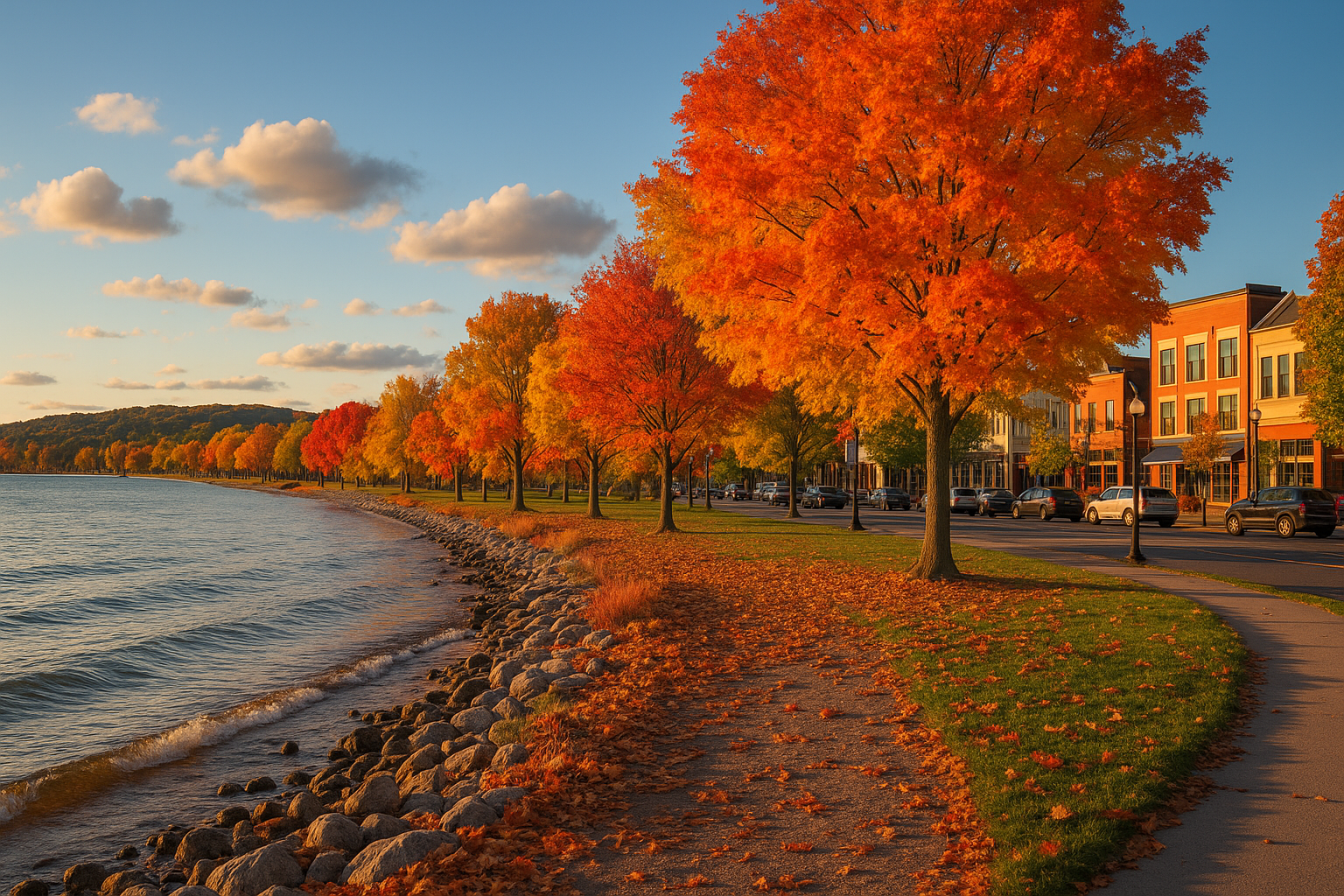
There’s something about fall in Traverse City that feels like a deep breath after a long sprint.
The air turns crisper. The sun sits a little lower in the sky, casting that golden light you only get this time of year. The trees trade in their greens for bursts of red, orange, and yellow — like they’re showing off before winter sets in.

The tourists have mostly gone home. You can actually get into restaurants again without standing in line for half an hour. The traffic moves a little easier. Parking downtown isn’t a competitive sport anymore.

Out on the bay, the water is still surprisingly warm. You can sneak in one last paddle or boat ride before it’s too cold to dip a toe. Everything just… slows down.

Summer’s stress — the crowds, the noise, the “go-go-go” — finally lifts. What’s left is a quieter, easier Traverse City. The one locals look forward to all year.

It’s the season of flannel shirts, cider mills, and evening fires. The season when the sunsets somehow get prettier, the air smells like leaves, and you remember why you live here.

Life slows down — and that’s just fine with me.


What Really Is a Podcast?

What is called a podcast has sparked more debate in our community than mic choices or interview styles.

There’s a lot of confusion, and even controversy, around this seemingly simple question. And if you’ve been in the podcasting game for any amount of time, you’ve likely heard a dozen different definitions.

According to WhatsAPodcast.com:

podcast (noun)
Episodic multimedia content that is downloadable via RSS (“really simple syndication”). A podcast can be audio or video.

Yes, this is technically correct. But let’s be real. That doesn’t really explain what a podcast is in the way that matters to us as creators.

A Podcast Is a Distribution Method, Not Just a “Show”

At its core, a podcast is a show distributed via podcasting technology. Namely, RSS feeds. That’s it. The magic isn’t in the audio file or video format, It’s in how it gets to your audience. A podcast isn’t just a genre of content, it’s a method of delivery. That’s a crucial distinction we, as creators, need to understand…  Even if our audiences don’t.

Listeners (or viewers, if it’s video) might never think twice about RSS. But we should. RSS is the backbone of podcasting. It allows for decentralized distribution, meaning no single company owns or controls where or how your content is accessed. That’s not a bug, it’s a feature.

Why YouTube Isn’t a Podcast (And That’s Okay)

There’s a common argument: “If I post my show on YouTube, that’s a podcast, right?”

Well…  Not quite.

A video uploaded to YouTube is a video. You might also be running a podcast that features the same content, but unless it’s distributed via RSS, it’s not technically a podcast. It’s just another method of media distribution. And, There is NOTHING WRONG WITH THAT.

There are many ways to distribute a show:

  • TV or radio broadcast
  • YouTube or other video platforms
  • Embedded audio on a website
  • Live streaming
  • Podcasting via RSS

The important thing is understanding what makes something a podcast: RSS-powered syndication that lets people subscribe (or follow) and receive new episodes automatically, in their preferred app, without being tied to any one platform.

Why This Matters to Independent Creators

You might ask, “Who cares if my content is called a podcast or not?”

Well, as an independent creator, you should care… at least a little. RSS keeps podcasting open and democratic. It’s what allows your show to appear on Apple Podcasts, Spotify, Pocket Casts, Overcast, and hundreds of other directories, all without being locked into a single ecosystem.

When your content lives only on one platform, you’re at the mercy of that platform’s algorithm, terms of service, and monetization policies. With podcasting, you own your feed. That’s powerful.

Use Podcasting as One Tool in Your Creator Toolkit

Here’s the good news: You don’t have to choose just one path. You can distribute your content however you like.

Record your live radio show? Great turn that into a podcast. Record a video for YouTube? Strip the audio and publish it as a podcast. Do a podcast? Add video and stream it live. Repurpose your content across channels. Just understand the distinctions.

Podcasting is just one way to reach your audience. But it’s a way that gives you freedom, control, and ownership. And that’s why it’s worth preserving the true meaning of what a podcast is.

A podcast isn’t defined by whether it’s audio or video, entertaining, educational or just plain stupid. It’s defined by how it’s distributed. Via RSS. Understanding that gives you more power as a content creator, not less.

Keep creating. Keep sharing. And most importantly, keep owning your feed.

HAPPY PODCASTING!

BBQ Served With a Side of Freedom! – Iron Pig Smokehouse

Iron Pig Smokehouse

This weekend, my wife and I had the pleasure of having dinner at the Iron Pig Smokehouse in Gaylord Michigan. I don’t normally do restaurant reviews on my blog or podcast, but I’m going to make an exception for this little piece of freedom just an hour from my house.  It’s just a short one.  You really need to go check it out for yourself if you are within striking distance of Gaylord.

First off, the story:

The Iron Pig is a funky little bar/restaurant in the small town of Gaylord Michigan which is is about half way between Lake Michigan and Lake Huron in the Northern Lower Peninsula of Michigan along I-75.  They made the local news (and maybe more) for their refusal to close down when the Governor and later the health department and liquor control commission ordered that inside dining not be allowed during the lockdowns in 2020 and early 2021. They were fined and their Liquor license suspended (which is proudly displayed on their bar).

They feel it’s a badge of honor.  Check out their site here:  https://theironpigsmokehouse.com/  They have t-shirts and other cool “gear” on the site all to support their cause and show your support. They also have copies of their legal documents from all the ‘trouble’ they have been in over the last year and a half.  Their motto is “Risk it for the Brisket!”

The Food:

I’m a lover of Texas-style bbq.  I love brisket and I love Mac and Cheese.  Let me tell you right now that their Brisket Mac and Cheese is the best I’ve ever had. I will make it point to drive an hour to get more several times over this summer for sure.  Everything we saw in there looked great and the people (both customers and staff) were top notch! My wife got the brisket platter. It was enough food for 2 meals at least.  (I enjoyed the leftovers for lunch today).

It was just great to get a little bit of “normal”.  It’s sad that freedom feels strange here in the USA.  We are adults and it was just nice to go to a place that treated us as such. I would highly recommend this place to anyone wanting great bbq with a side of freedom!

Put this address in your GPS and head on up!  143 W Main St, Gaylord, Michigan 49735

They are open 7am to 9pm 7 days a week.  Maybe you will see me in there (face and all) eating some good Mac and Cheese!

People need to mind their own business and BE NICE! (Dammit!)


In Michigan, we have a bottle and can deposit law which makes it necessary to make trips to the bottle return at stores like Meijer and Walmart. Today, I was cleaning the garage and had a load of cans and bottles to go back to the store. Stores that sell beverages that have deposits are required to take back the cans and bottles and pay you back for your deposit.

2 things happened to today that makes me wonder WTF?

First, I was parked at Meijer in Acme and I was a ways away from the cart return. I had enough cans that I needed to get an empty cart to take them all in. I’m walking to the cart return and some woman comes running up to me (less than 2 feet away) and starts giving me crap about not wearing my mask. I said, “you are standing 2 feet away from me. We are outside and masks are NOT required. Please back off.” (Yes I do wear a mask where required.) She started going off on me more as I walked a way and told her to STFU and stay away from me.

Then, I return my cans and had a $15 return slip which you are supposed to turn in for cash in the store. I go in the store and got a few things. In the checkout, It worked out to be $9 and something so I would get $5 something back. The cashier started freaking out on me telling me that I can’t return cans for more money that what I was going to spend. She was EXTREMELY rude to me. I just said, I didn’t see anything about that on any signs and besides that, the law says I can get cash for the cans. She grumbled something and went off and came back with my $5.

People… PLEASE, Mind your own business and just be nice. That was way uglier then it had to be. The cashier was wrong. I’m going to guess she’s having a bad day. But, really?? #fail #meijer #mask #BS

Tired of Facebook and others censoring you?

My friend Suzie Had this warning on her Facebook Profile.  Facebook, Which owns THEIR SYSTEM decided that whatever article she clicked like on was false, based on what the government (or World Health Organization in this case) said.   It’s their right to censor what is on THEIR platform.

Social media sites like Twitter, Facebook, Instagram, TickTock (sp?) and Google (YouTube) have that right. Their platforms are owned privately by those companies.  That gives them the right.   BUT, you do not have to live by the rules!  Take back the web from these “Social (engineering) media companies”.


Free speech is something we enjoy in the US and a lot of other places around the world.  It’s a god-given right of all humans.  BUT you don’t have the right to be heard on someone else’s platform. Just like you don’t have the RIGHT to be on the NBC evening news.  NBC has that right and they can allow you on there if they deem it important.  Just like these social media platforms. Yes, they make it much easier to get heard (or read) but they don’t guarantee it.  They also control who sees what and when.  They advertise against it (which is their business model).  But, to use them as your “platform” to be heard is not always the best plan.  It’s like building your house on rented land.

I’m not here to say who’s right and who’s wrong.  That is up to you, but the example I use is Alex Jones. Regardless of what you think of his opinions, he is a good example of someone that is being de-platformed by the main stream social media companies.  Apple, Google (YouTube), Facebook and Twitter (and I’m sure many more) have made it so you can’t find his stuff in those places. BUT, he still is out there. He has a podcast (several I think, I don’t listen to him).  He has a website and can say and do what he wants.  You can get his podcast and read his articles if you want.  You know why?   Because he has his OWN platform. Getting the word out is a little harder for him, but he’s still saying what he wants, when he wants.

You can do that as well.

Get your own WordPress BASED website (Not WordPress DOT COM).  Any webhost that can install WordPress works.  I use A2 hosting (see banner on the side bar of this page)   It’s cheap, mostly easy and the great thing is I OWN IT.   I can put what I want on this site and nobody can tell me to take it down. Nobody can just take it down because they don’t like it or it doesn’t comply with some sort of rule.  I can post Pictures, Videos, Audio Podcasts or just type whatever I want here.  IT’s MY WEBSITE.  Does not belong to the Social (engineering) Media companies.

Yes, it’s true that more people “COULD” see a post on social (potentially) than this site.  But if Facebook, Twitter, Instagram or YouTube do not want me to say something, they can take it out.   If they don’t like something on this page, they CAN’T take it out.

Freedom of speech is just like all the other rights out there.  Use it or lose it.

Godaddy Hosting – Good to Crappy in 3 Months

Since 1999, I have had MikeDell.com on the web.  The first few versions of it were just done on plain old HTML and then later FrontPage.  I went through a few web hosts over the years since around 2003 I’ve been on Godaddy hosting and WordPress.  I was on the mid-level shared hosting on Linux which allowed several websites to be hosted.   It was all going great for 17 years, until Godaddy informed me that I couldn’t update my PHP to the version needed to run the current version of WordPress and PowerPress.  They were getting rid of the servers that I was on an I had to move.

NORMALLY, when a web host wants to move you, they just move you and you don’t really have to do anything.  They just do it for you and it all goes well.  In the case of Godaddy, that was NOT the case.  Not only did I have to buy a plan (I got what I thought was the equivalent “new” hosting plan on the newer style servers.   Not that big a deal, but then I found out they would move my sites, but for $199 EACH!  –  STRIKE ONE

So, they send me some lame instructions on how to move a WordPress site ( I had 5 at this point ).  I just did it the way I know how and it did work.  The trouble started very shortly after that.  All my sites went down one day a week later.  I tried and tried to get to any one of them with no luck at all.   I called into Godaddy and they said first there was an issue they were working on.  SO I waited another day or two.  Still down.   SO I called back in.  This time they said, “you are using too many resources.”   I asked,  Really?  I have 5 WordPress sites and none of them are very busy.  The nice support lady said I should upgrade to the next level of shared hosting.   Since I had paid for a year at a time, I would have to pay the whole year at the new level (pro-rated) on the new plan…..    OK…. I suppose if you think it will help.   So I upgraded.    Sites came back but were a bit slow.  Figured it would take time to get back up to speed.

A week later, they were all down again.    This time they told me it was Malware on my sites.   I asked “what malware”  They said….   “Well, we can do a scan but you have to buy our super-duper security service for your site.”  “You know WordPress is very prone to be hacked”   That will be $39 per month.   (I refused because they were full of crap FYI) I gave it a bit of time.  Got rid of some plugins and things I didn’t really need and generally cleaned up a ton of unused stuff on the server.   It sped up a bit after that.

Then, a couple of weeks later…  Sites are down again.   I called in, and got the “you are using too much resources” thing again….. IOk,  I call Bullshit.  I asked them to tell me WHAT, in my very low traffic sites, is causing your server so much trouble?    They couldn’t tell me without a consult ($$$) with their “server team”,  but offered yet another expensive upgrade.   STRIKE TWO!

I moved MikeDell.com at that point.  It moved to Blubrry PowerPress sites (Use my Promo code MIKE for a free month if you want one) and I’m using PodcastMirror.com to take the feed traffic off the site. (Update, I moved MikeDell.com to A2 hosting as well)  It’s now a rocketship, but that still left the other 4 sites, slow as shit.    I called again and was told “You are using too many Resouces.   STRIKE THREE!

I went on a search for better hosting.   I found A2 Hosting right here in Michigan (Ann Arbor) and the price was about the same as I was paying for many years at Godaddy before the “upgrade”.  I signed up and figured I would try it.   Well, the first thing I noticed was the test site I put on there was VERY fast.   No issues with downtime, no issues with any other troubles.   I also saw on A2’s website that they will move sites for you.  (I was skeptical) but I thought “What the heck?”.  I put in a request and they asked for my login info to my Cpanel over a godaddy.   3 hours later, all my sites were copied over with all the settings, passwords and everything.   All I had to do was switch the DNS’s.    Less than 12 hours from start to finish, iook.org, benz-arpsc.org, traversecityclassof64.com and W8TVC.com were moved, had shiny new FREE SSL certs and were VERY fast.

I’m not sure what went wrong at Godaddy.  They were always very good and I’ve been an affiliate of theirs over the years. I think what might have happened is the guy that started it, Bob Parsons left the company.   He was a very strong CEO and had the customer in mind, not just making money.   Their support used to be top-notch.  Now they are just upselling. Upsell upsell upsell in support.  Throw money at it.  Extract every sale you can even if it’s not needed.    I still use them for domains (for now).  But I have canceled my hosting plan and (Very overpriced SSL Certificates.

I am an affiliate with A2 hosting now (none of my links are in this article) and so far I am a very happy, former Godaddy Hosting customer.