There’s been a lot of talk lately about video podcasting. Everywhere you look, somebody is telling podcasters they need to be doing video. YouTube is a huge player in the podcasting space, Spotify is pushing video, and Apple is expanding its video capabilities. And that’s great. Really, it is. But somewhere in all the excitement about video, I think we’re forgetting something important. Audio is special. Not just because it’s how podcasting started, but because audio offers something that video simply cannot replace.
I’ve been involved in podcasting for more than 21 years, and I’ve been an audio listener for a whole lot longer than that. The more I think about where podcasting is heading, the more convinced I am that audio is still the heart of this medium.
Audio Has Always Been My Companion
Long before podcasts existed, I worked overnight shifts in a print shop. When you’re working those kinds of hours, having something to listen to makes a tremendous difference. Radio was my companion. It kept me entertained, informed, and connected to the world while I was doing my job. I didn’t have to stop working to enjoy it, and I didn’t have to look at a screen. I could just listen. That experience stuck with me.
Years later, when podcasting came along, I immediately understood the appeal. Here was something that offered the same companionship as radio, except now I could choose exactly what I wanted to listen to and when I wanted to hear it. That was pretty revolutionary. I could listen to technology discussions, aviation stories, news, or just a couple of people having an interesting conversation, and I could do it while doing something else.
Fast-forward to today, and I’m still doing exactly that. I’ve recently started going to the gym again, and podcasts are part of the experience. I can put on my headphones, listen to a show, and work through my exercises. The technology has changed enormously since those overnight shifts, but the experience really hasn’t. I’m still listening to interesting people while I go about my day.
Audio Fits Into Your Life
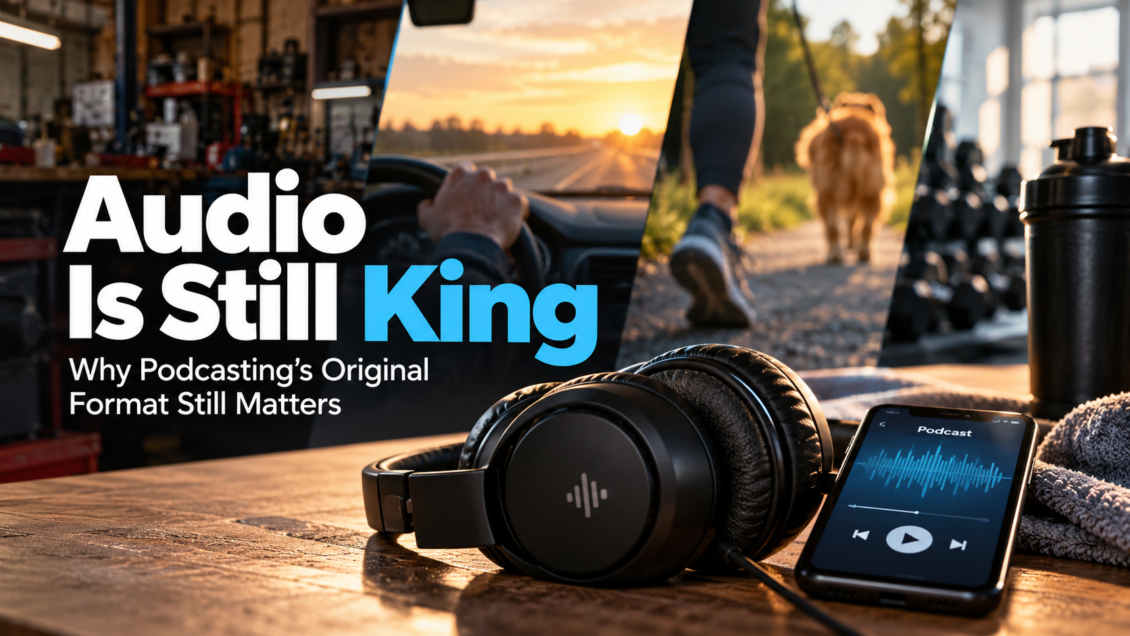
This is probably the single biggest advantage audio has over video. You can listen to audio almost anywhere. Driving down the road, walking the dog, working in the garage, mowing the lawn, doing household chores, or exercising are all opportunities to listen to something interesting. You don’t have to dedicate your eyes to a screen, and that’s a pretty big deal.
We live in a world where just about everything is competing for our visual attention. Phones, computers, televisions, social media, and endless video feeds all want us to look at something. Audio doesn’t demand that. It allows us to do other things while still enjoying content. Think about how many hours people spend driving, commuting, walking, or working on projects. Those are opportunities for audio that simply aren’t practical for video.
Sure, you can play a YouTube video in the background and just listen to it. I do that myself sometimes. But when you’re doing that, you’re essentially treating the video as an audio program. And I think that says something important. Sometimes the pictures just aren’t necessary.
There’s Something Personal About a Voice
Here’s the part that I think gets overlooked the most. Audio creates a connection between the host and the listener that is remarkably intimate. Think about it. When somebody listens to your podcast with headphones, your voice is literally right there in their head. You’re talking directly to them. Not to a room full of people or an audience sitting in front of a television, but to that individual listener. Of course, as a podcaster, you might have hundreds, thousands, or even millions of people listening. But each individual listener is having their own experience with you.
Over time, something interesting happens. Listeners start to feel like they know you. They recognize your voice, understand your sense of humor, and pick up on your personality and habits. They can sometimes tell when you’re excited about something, frustrated, tired, or just having a particularly good day. And all of that happens without ever seeing your face.
I’ve experienced this from both sides of the microphone. I’ve listened to certain podcast hosts for years. In some cases, I feel like I know these people, even though we’ve never met. And after more than two decades of producing podcasts, I’ve had listeners approach me at conferences and talk to me like we’ve known each other forever. From their perspective, in a way, we have. They’ve spent hours listening to me talk. That’s a pretty remarkable relationship when you stop and think about it.
Now, video can certainly create connections too. I’m not suggesting otherwise. But there’s something about audio that allows the listener to build their own mental picture of the person speaking. It’s a little like reading a book versus watching the movie. Your imagination gets involved, and sometimes that makes the experience even more personal.
I’m Not Against Video Podcasting
Let me make something perfectly clear. I’m not anti-video. In fact, at Blubrry Podcasting, where I work, we’re actively developing and supporting video podcasting technology. Our own company podcast, Podcast Insider, is moving into video production. We offer technology that allows podcasters to upload video and distribute their content to both audio and video platforms. With Apple’s HLS technology, listeners can even switch between audio and video while keeping their place in the program. I think that’s fantastic.
But here’s the thing. Just because we can add video to podcasting doesn’t mean every podcast needs it. Some shows absolutely benefit from video. If you’re demonstrating something, showing how to repair a piece of equipment, or discussing something highly visual, video can be incredibly useful. But what about two people having a conversation? What about an interview or somebody telling a story? Does seeing two people sitting in front of microphones really add that much to the experience? Sometimes it does, and sometimes it doesn’t. I think we’ve gotten a little carried away with the idea that every podcaster needs a camera.
Video production also introduces additional work. Lighting, cameras, backgrounds, editing, and the pressure to look presentable are all things that audio-only podcasters don’t necessarily have to worry about. One of the beautiful things about podcasting has always been its relatively low barrier to entry. You have something interesting to say, a microphone, and a way to publish it? You can be a podcaster. I don’t want us to lose sight of that.
Let the Audience Decide
After more than two decades working in podcasting, one thing I’ve learned is that listeners have different preferences. Some people love watching video podcasts, while others prefer listening as they drive or work. Plenty of people do both, depending on the situation. Why should we force them to choose one format?
That’s one of the things I like about the direction podcast technology is heading. At Blubrry, we’ve been working on ways to make it easier for creators to distribute both audio and video without having to manage completely separate production and publishing workflows. A creator can upload a video, and the technology can make that content available to people who want to watch and people who just want to listen. That’s the kind of innovation I can get behind. Not video replacing audio or audio fighting against video, but simply giving the audience more choices.
Ultimately, the listener should decide how they want to consume your content. If somebody wants to listen to your show while walking three miles, they shouldn’t have to stare at their phone to do it.
Audio Isn’t Going Anywhere
Podcasting has changed dramatically since I first got involved more than 21 years ago. We’ve gone from a relatively small group of technology enthusiasts experimenting with RSS feeds and MP3 files to a massive worldwide industry. We’ve seen major platforms enter the space, new advertising models, subscription services, and now an enormous push toward video. There will undoubtedly be more changes coming, and I’m looking forward to seeing what happens next.
But I keep thinking back to those overnight shifts at the print shop. I had work to do, and I wanted something interesting to listen to while I did it. That’s really all it was. Today, whether I’m driving, walking, working around the house, or exercising at the gym, I still want the same thing. A good story, an interesting conversation, a familiar voice. Something that makes the time pass a little faster or teaches me something I didn’t know before.
Video is a wonderful addition to the podcasting world, and I’m excited to see where it goes. But I don’t believe it’s going to replace audio, because audio isn’t simply video without pictures. Audio is its own experience. It’s personal, portable, and intimate. It lets us bring other people’s voices and stories into our everyday lives without requiring us to stop living those lives.
And after all these years, I still think there’s something pretty magical about that.
Audio isn’t going anywhere. And that’s a good thing.